Home › Articles › Best Calculators for CFA Candidates
The Best Financial Calculators for CFA Candidates: HP-12C vs BA II Plus, Decided
The CFA Institute approves exactly two calculators for the Level I, II, and III exams. Bring anything else and it gets confiscated at the door. So the question for every CFA candidate isn't which calculator is best — the field is two. The question is which of these two is right for you, and that depends on whether you've ever touched RPN before, whether you'll be sitting on a trading floor surrounded by HP loyalists, and how much patience you have for a learning curve that runs about a week. Here's the honest comparison.
Last updated: July 29, 2026. Prices reflect typical Amazon retail as of late July 2026. Affiliate disclosure.
Quick answer: If you've never used either, buy the BA II Plus Professional. It's cheaper, easier to learn, and slightly better-suited to the question style on Levels II and III. If you've used any HP calculator before, work on a finance desk, or just prefer the cultural fit of the device that's been on Wall Street for 45 years, buy the HP-12C. Both are excellent. Neither is objectively wrong.
How we ranked these
This is a two-product field by definition: the CFA Institute's approved-calculator list has two entries. Our ranking criteria, in order:
- Learning curve. How fast a candidate with no prior calculator experience can become exam-fluent on it.
- Speed at exam-style problems. Once fluent, how many seconds per problem the calculator costs you compared to the alternative.
- Career portability. Will you still be using this calculator at your desk five years after the exam?
- Price and longevity. Total cost of ownership over the typical 6-8 month CFA Level study period plus 5+ years of professional use afterward.
We do not weight features that aren't tested on the CFA exam (graphing, programming languages, advanced statistics) — both calculators have enough math for the curriculum, and the marginal feature differences are not exam-relevant.
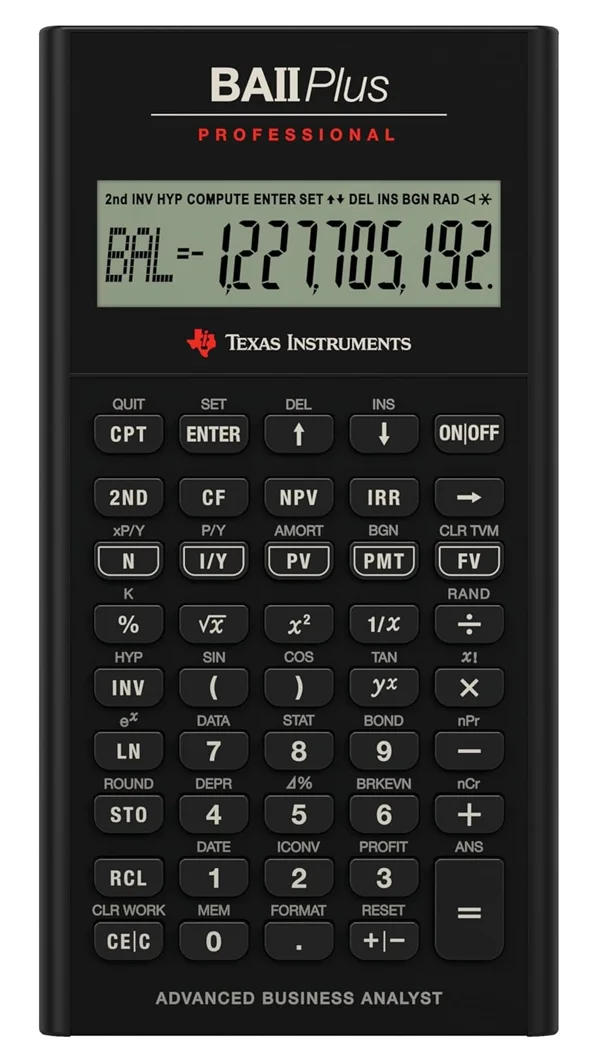
1. Texas Instruments BA II Plus Professional — the easier path
$45–60 · Buy on Amazon →
The BA II Plus Professional is the calculator most CFA candidates buy and most CFA candidates pass with. It uses standard algebraic input — type 2, +, 3, =, get 5 — which is the input method every other calculator you've ever used works with. There is no learning curve for the input method. The learning curve is just memorizing where the time-value-of-money keys live, which is a couple hours of practice.
Who it is for: First-time CFA candidates with no prior financial-calculator experience. Anyone who has used an algebraic calculator their whole life and doesn't want to fight muscle memory. Candidates who care more about exam efficiency than career signaling. Anyone who has heard about RPN and quietly thought "no thanks."
What you actually get: Time-value-of-money (N, I/Y, PV, PMT, FV) on dedicated keys. Cash flow worksheet for irregular cash flow problems (NPV and IRR on up to 32 cash flows). Bond pricing worksheet. Statistics worksheet with regression. Depreciation worksheet (straight-line, sum-of-years-digits, declining balance, French straight-line, French declining balance). Modified internal rate of return — which the regular BA II Plus does not have. Modified duration. Payback and discounted payback period. The "Professional" version's added worksheets are exactly the ones that come up in Level II and Level III.
The catch: The button feel is fine, not great. Texas Instruments has not redesigned this calculator since 2004, and you can tell — the keys have a slightly mushy travel that becomes annoying on a six-hour cumulative study session. Build quality is acceptable, not heirloom — expect to replace it at least once if you keep using it for 10+ years. Battery life is decent (about 1,500 hours) but worse than the HP-12C's eight-to-ten-year coin cells. None of this matters for the exam itself.
Cheaper alternative: The regular Texas Instruments BA II Plus (without "Professional") is $35-50 and is also CFA-approved. It does almost everything the Professional does, missing the modified IRR, modified duration, and payback worksheets. For Level I it's plenty. For Level II and III the Professional is worth the $15 — both because of the worksheet additions and because you avoid the mid-program calculator switch. If you're committing to all three levels, save the $15 in a different way.
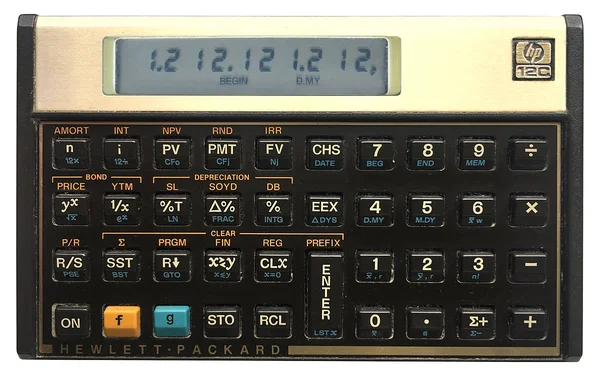
2. Hewlett-Packard HP-12C — the desk calculator of Wall Street
$45–60 · Buy on Amazon →
The HP-12C is the most enduring consumer electronics product on record — released in 1981, still made today in essentially its original form, and the unofficial uniform of Wall Street trading floors and real estate negotiation tables. It uses Reverse Polish Notation (RPN), which means you push numbers onto a four-level stack and then operate on them: to compute 2 plus 3, you press 2, ENTER, 3, +. There is no equals key. There are no parentheses. After about a week, RPN becomes faster than algebraic input for chained financial calculations — which is most of what the CFA exam tests.
If the cultural side of this is interesting, we have a deeper piece: The HP-12C: The Financial Calculator That Refused to Die. The short version is that HP has tried to retire it four times in 45 years and failed every time, because customers refuse to switch.
Who it is for: CFA candidates who are also working on a finance desk where the HP-12C is the cultural default — banks, brokerages, real estate, private equity, sovereign wealth. Candidates with prior HP calculator experience or any RPN exposure. Anyone who wants the calculator they buy for the CFA to also be the calculator they use professionally for the next 30 years.
What you actually get: The same five core TVM keys (n, i, PV, PMT, FV) but on a smaller, denser keyboard with a gold-on-black faceplate. 99-step keystroke programming for repeated calculations. Bond pricing and yield-to-maturity. IRR and NPV on up to 20 cash flows (vs the BA II Plus's 32 — the gap rarely matters in practice; CFA problems max out around 8-10 cash flows). Statistics with linear regression. Depreciation: straight-line, sum-of-years-digits, declining balance. Eight-to-ten-year battery life on three coin cells. Build quality that genuinely outlives many of the people who own it — units from 1985 still work in 2026.
The catch: RPN. There is no way around it. You will spend the first three to seven days of practice fighting your algebraic-calculator muscle memory and feeling slow. Around day 5-7 the stack model clicks and you stop fighting it. After day 14 you are faster than you were on a regular calculator, but the path there is uncomfortable and some people give up before they get to the click. The other catch is that the HP-12C menu system is genuinely ancient — to use a worksheet (cash flow, bond, depreciation), you press the function in the gold/blue shift layer rather than navigating a menu. It's not difficult once you know where things are; it just isn't discoverable.
Cheaper alternative: Refurbished HP-12C units from HP's outlet store occasionally appear at $50-60 and are functionally identical to new. eBay used units run $30-50 and are reliable, but the savings aren't worth the risk for a calculator you'll depend on for a $1,000+ exam — get the new one. The HP-12C Platinum at the same retail price has 6× the speed and an algebraic mode option, but most veterans dislike the subtle differences in stack behavior; if you specifically want RPN, the original is more portable across the HP-12C user community you'll be joining.
The decision tree
Three honest questions, each one decisive:
1. Have you ever used an HP calculator with RPN before?
- Yes → HP-12C. You already know it. Don't switch.
- No → continue.
2. Do you work (or want to work) on a Wall Street trading floor, in real estate negotiation, or in a finance role where the HP-12C is the cultural default?
- Yes → HP-12C. The exam is one weekend; the desk culture is a decade. Match the desk.
- No, or unsure → continue.
3. Do you have at least 6-8 weeks of daily practice time before your exam?
- Yes → either is fine; the BA II Plus Professional is the slightly safer pick because the algebraic input lets you focus more practice time on financial concepts and less on calculator mechanics.
- No, you're closer to 4 weeks → BA II Plus Professional. The RPN learning curve will eat practice time you don't have.
For most first-time candidates the answer is the BA II Plus Professional. For most candidates already in finance, the answer is the HP-12C. There is no third right answer.
The used market reality check
Both calculators have huge installed bases and active used markets. Some honest math:
HP-12C used: $30-50 on eBay in working condition, abundant supply going back decades. Battery is replaceable (three CR2032 coin cells, ~$3 from any drugstore). Older units (pre-2008 ARM-emulator era) have a slightly different feel — keys with more positive click — and many enthusiasts prefer them. For exam use, any working unit is fine. The risk is buying a unit with a worn-out display or sticky keys, which is hard to verify in photos.
BA II Plus used: $20-35 on eBay. Lower demand than the HP, so prices are softer. Battery is replaceable but the procedure is mildly annoying (small Phillips screws). Build quality is more variable — some 2010s-era units have battery contact corrosion that disables the calculator and is fixable but nuisance.
For a $1,000+ exam where calculator failure on test day is a catastrophic outcome, the new-buying premium is worth it. Save the $30-40 on something else; don't save it on the device that does every calculation that matters.
What you don't need (and is not allowed)
Common things candidates ask about that are not approved for the CFA exam:
- Smartphones with HP-12C or BA II Plus emulator apps. The apps are excellent for studying. Phones cannot enter the testing room.
- Texas Instruments TI-84 graphing calculator. Approved for the SAT and ACT; not approved for the CFA.
- HP-17B / HP-17BII business calculators. HP's own newer business line. Not on the CFA approved list.
- HP Prime graphing calculator. HP's flagship modern device. Not on the CFA approved list.
- Casio fx-991ES Plus or any other scientific calculator. Not on the CFA approved list, regardless of how good it is for engineering math.
- Smart watches. Banned in the testing room entirely.
The CFA Institute updates the approved list periodically; check the official calculator policy within 30 days of your exam to confirm.
Frequently asked questions
Which calculator is allowed on the CFA exam?
Exactly two: the Hewlett-Packard HP-12C (in any version, including the Platinum, Prestige, 25th Anniversary, and 30th Anniversary editions) and the Texas Instruments BA II Plus (including the Professional version). No other calculator is permitted in the testing room. Bringing any other model — even a more advanced HP or TI — will get it confiscated at check-in.
Should I buy the BA II Plus or the BA II Plus Professional?
If you're committing to all three CFA Levels, get the Professional. The added worksheets (modified IRR, modified duration, payback, discounted payback) come up in Level II and Level III, and the $15 premium is worth not having to relearn a calculator mid-program. If you're only taking Level I and considering whether to continue, the regular BA II Plus is sufficient and saves you $15.
How long does it take to learn RPN on the HP-12C?
About a week of regular practice for the stack model to click, two weeks to be as fast as you were on an algebraic calculator, and three to four weeks to be measurably faster. The first three to seven days are uncomfortable — your hands keep reaching for an equals key that isn't there. Around day 5-7 the four-level stack stops being a thing you think about and starts being a thing you use. If you have only four weeks before your exam and have never used RPN, this is too tight a window — buy the BA II Plus Professional and skip the learning curve.
Can I bring a backup calculator to the exam?
Yes — the CFA Institute explicitly permits bringing a second approved calculator into the testing room as a backup, in case the primary fails. Many candidates do this. The backup must also be from the approved list (HP-12C or BA II Plus). The most common combination is one of each: an HP-12C as primary and a BA II Plus Professional as backup, or vice versa. Both calculators must clear the check-in inspection. Bring fresh batteries, or fresh-enough batteries — both calculators have battery indicators that warn well before failure, but a battery dying mid-exam is the kind of stress nobody needs.
Are emulator apps useful for studying?
Yes, with one caveat. The official HP "HP 12c Financial Calculator" app, the Texas Instruments BA II Plus emulator on the TI website, and well-regarded third-party apps (Touch RPN for HP-12C, "Financial Calculator HD" for BA II Plus) are excellent for studying when your physical calculator isn't with you. The caveat: do not let app practice replace physical-calculator practice. Test-day muscle memory is built on physical keys, not virtual ones, and the slight differences in tactile feedback matter when time pressure hits. Use the app in line at the coffee shop; use the physical calculator for every mock exam.
What if my calculator dies during the exam?
If you brought a backup, switch to it. If you didn't, raise your hand and the proctor will let you continue with whatever functioning means you have (the actual policy: candidates may continue with mental math). This is a bad outcome and is exactly why bringing a backup is worth $50. New batteries the morning of the exam are the cheapest insurance available; don't show up with a calculator you haven't powered on in three weeks.
Can I bring a calculator I bought used?
Yes. The CFA Institute does not require a new calculator. As long as the calculator is on the approved list, in working condition, and has all standard markings (the model name visible, no apparent modifications), it will pass check-in. The risk with used units is reliability, not eligibility. For a $1,000+ exam, the $30-40 saved on a used unit isn't worth the risk of test-day failure.
The bottom line
Two calculators are approved. Either will get you through the CFA exam if you put in the practice. The BA II Plus Professional is easier to learn and slightly cheaper. The HP-12C is faster once learned and matches the desk culture of most finance careers. Pick on those two axes — learning curve and career fit — and don't let the choice become the bottleneck on your study plan.
Buy whichever one matches your situation, buy it the same day you register for your exam, and put 60+ hours of practice on it before test day. The calculator is a multiplier on the studying you do; it isn't the studying.
Affiliate disclosure
The Amazon product links on this page are affiliate links. If you buy through them, we earn a small commission at no extra cost to you. As an Amazon Associate we earn from qualifying purchases. Our recommendations are based on the calculators' fit for the CFA exam and on long-term value; the affiliate relationship does not influence which calculators we recommend or how we rank them.
This article is for general education and is not financial advice. Calculator approvals and pricing are accurate as of May 2026 and are subject to change; verify against the official CFA Institute calculator policy 30 days before your exam. See our Terms.