The HP-12C: The Financial Calculator That Refused to Die
In September 1981, Hewlett-Packard shipped a $150 financial calculator the size of an index card with a weird input method nobody else used and a gold-on-black faceplate that looked already a decade out of date. Forty-five years later, you can still buy one new from HP. Same shell. Same keys. Same Reverse Polish Notation. Same target customer. The only thing that's changed is the processor inside, which now emulates the original. It is the longest-shelf-life consumer electronics product ever sold, and an entire industry refuses to retire it.
Last updated: May 19, 2026.
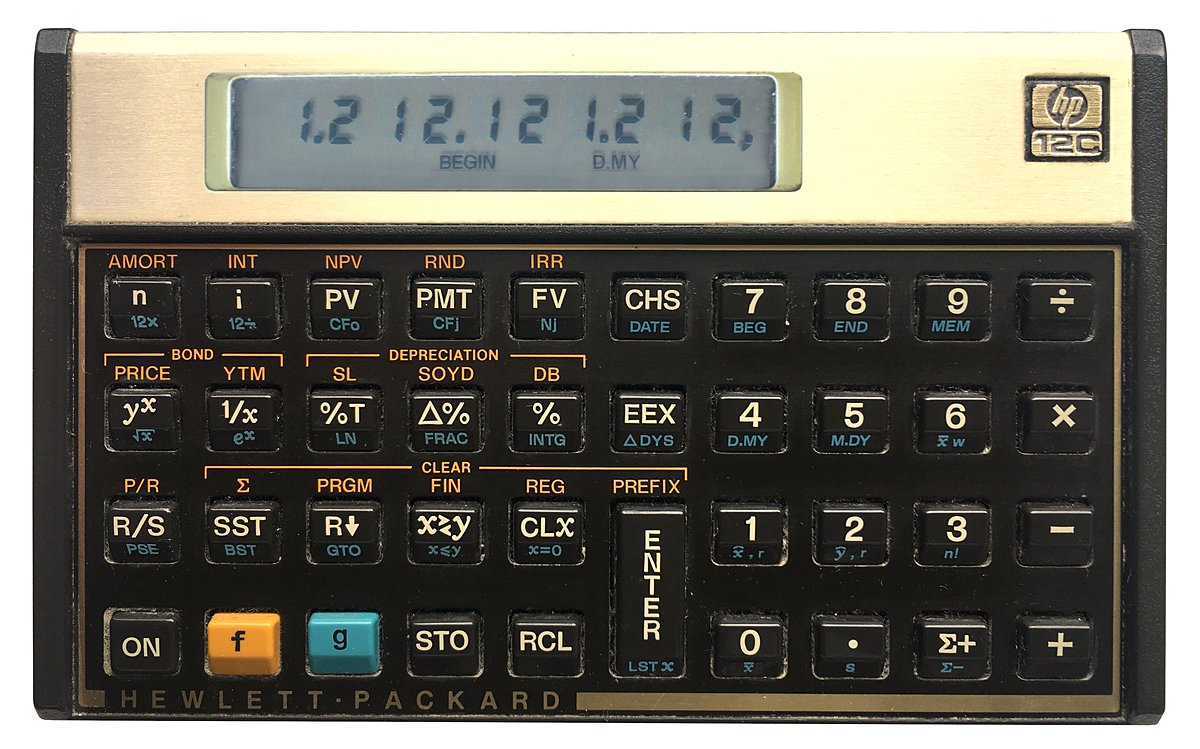
A 1988-production HP-12C, identical in layout and function to the 2026 model. Image courtesy of Wikimedia Commons (CC0).
What the 12C actually is
The HP-12C is a programmable financial calculator. Landscape orientation, 130 grams, 5.0 by 3.1 by 0.6 inches — about the dimensions of an old-school index card and just over half an inch thick. The 1981 original ran on a custom HP Nut CPU at about 640 kHz. The modern 2026 production unit uses an ARM Cortex chip running a software emulator of the Nut, so the calculation results bit-match what came out of the original.
Hardware specs are not the story. The story is the user interface.
The 12C has 39 keys. Most carry three labels — a primary function, a gold-shifted function (press f then the key), and a blue-shifted function (press g). The five most important keys sit in the top row: n (number of periods), i (interest rate per period), PV (present value), PMT (payment), and FV (future value). Those five letters are the entire language of time-value-of-money math, and the 12C lets you solve for any one of them given the other four.
There is no equals key. There are no parentheses. The 12C uses Reverse Polish Notation, which means you type the operands first and the operator last. To compute 2 + 3, you press 2, ENTER, 3, +. The calculator maintains a four-level stack (registers X, Y, Z, T); each operator consumes the top values on the stack and pushes the result back. Once you internalize it, you stop thinking in algebra and start thinking in pipelines.
Why it shipped this way
Hewlett-Packard had been making RPN calculators since the HP-35 in 1972 — the first scientific pocket calculator and HP's first consumer product. By 1981, every HP calculator used RPN and HP customers expected it. The 12C was designed for one specific market that HP knew well: financial professionals coming out of the HP-80 (1973) and HP-37E (1978) tradition. RPN was their default. Algebraic input would have been the strange choice.
The other reason was math. Financial calculations are deeply nested. Bond yield-to-maturity is a present-value equation iteratively solved for the interest rate. IRR on a 30-period cash flow involves stacking and unstacking values constantly. In RPN, you build the answer by pushing pieces onto the stack and operating on them in flow; in algebraic, you write a parenthesized expression and hope you closed the right ones. On real workloads — not 2 + 3, but a 20-row amortization schedule — RPN is noticeably faster once you learn it. HP measured this. So did their customers.
The third reason was the chip. The HP Nut CPU had limited RAM and a small ROM. Implementing an RPN parser is trivial — push, pop, operate. Implementing an algebraic parser with proper operator precedence is much harder. HP chose the cheaper implementation that also happened to be the one their customers preferred. Constraints and preference aligned. The 12C shipped with RPN, and stayed RPN.
The accidental immortality
HP did not set out to make a 45-year product. The plan in 1981 was the standard consumer-electronics plan: ship the 12C, run it for five years, replace it with a better one. They tried. Repeatedly.
- HP-19B (1988). A "business consultant" with a multi-line LCD, algebraic mode, menu-driven interface, and a soft-keyboard system. The product was supposed to make the 12C look obsolete. It did not. Financial analysts hated the menus, missed the dedicated TVM keys, and refused to switch.
- HP-17B (1988) and HP-17BII (1990). Same architecture as the 19B, simpler form factor. Also tanked. The 12C kept selling.
- HP-12C Platinum (2003). An "upgrade" that added algebraic mode as an option, doubled the memory, and ran 6× faster. Customers complained that the new RPN behavior differed subtly from the original in edge cases (the way
ENTERinteracted with the stack-lift flag) and refused to standardize on it. HP eventually re-released the original 12C alongside the Platinum because the original was outselling the upgrade. - HP-30b (2010). A business calculator with a fast ARM chip, multi-line display, two-line entry, and the option to flash custom firmware (which the homebrew community took advantage of). It died at retail. The 12C kept selling.
By 2008, HP was on its third or fourth attempt to retire the 12C and had given up. Internal HP documents from the period — leaked years later to enthusiast communities — show the marketing team referring to the 12C as "the immortal" and noting that any attempt to discontinue it triggered phone calls from large institutional buyers (banks, brokerages, the CFA Institute itself) asking when supply would be guaranteed for the next decade.
So HP kept making it. They modernized the inside — current production units use a 2012-era ARM Cortex running a Nut emulator — but they did not touch the outside. The keys still feel the same. The case still has the gold faceplate. The print on the keys is still the same font as 1981. Buy a new one today and a 1985 owner will not be able to tell which is which without checking the serial number sticker.
The CFA exam lock-in
The single most important reason the HP-12C survives is the CFA Institute's calculator policy. Since the program's modernization, the Institute has approved exactly two calculators for use on the CFA Levels I, II, and III exams: the HP-12C (and 12C Platinum) and the Texas Instruments BA II Plus (and BA II Plus Professional). Nothing else is allowed in the testing room.
That policy has been stable for decades. Roughly 400,000 candidates sit for some level of the CFA exam each year. A large share of them buy or borrow one of the two approved calculators, learn it well enough to pass three difficult exams, and then keep using it for the rest of their career because muscle memory is expensive to rebuild. The result is a self-reinforcing loop: the calculator is on the exam approval list because it is in widespread professional use, and it is in widespread professional use because it is on the exam approval list.
Other professional certifications layered onto the same lock-in. The Appraisal Institute's MAI designation, the Real Estate Salesperson exam in several US states, and various banking-association certifications all reference either the 12C or the BA II Plus in their study materials. None of them mandate the 12C, but the cultural default is set.
What it does well that a spreadsheet does not
The obvious question in 2026 is: who needs a $80 calculator when Excel ships free with every Office subscription and HP-12C emulator apps run on every phone? The answer is more interesting than nostalgia.
Speed at small problems. Compute the monthly payment on a $300,000 loan at 6.5% over 30 years: on the 12C it's six keystrokes — 360 n, 6.5 g 12÷, 300000 PV, 0 FV, PMT. Total elapsed time: about four seconds. Opening Excel, finding the PMT function, remembering the argument order, formatting the rate-per-period — call it 90 seconds for the same answer. For one-off calculations during a meeting or a phone call, the calculator wins.
No setup, no state. A spreadsheet model carries assumptions, named ranges, conditional formats, hidden columns, and the previous user's mistakes. A calculator has none of that. Every problem starts from an empty stack. When you want to actually understand what you're computing — instead of trusting an inherited spreadsheet — the 12C makes you do the math yourself.
Examinable surface area. Anyone who has been on a trading floor or in a real-estate negotiation knows the moment: the deal is at a number, the buyer or seller asks "what's the cap rate at $X," and an Excel-only analyst freezes. A 12C user keys it in. The number is a data point in a conversation, not a deliverable in a workflow.
It doesn't crash, run out of battery mid-meeting, or get a software update that breaks IRR. Three coin cells, eight to ten years. The calculator is a tool. The spreadsheet is an application.
The lesson: when the interface is the product
The HP-12C is a master class in the difference between a feature set and an interface. The feature set — TVM, amortization, IRR, NPV, depreciation, statistics — has been available on dozens of competing calculators and in every spreadsheet for decades. None of those replaced the 12C. What HP got right was the keyboard layout, the gold-and-black color scheme, the heft of the case, the click of the keys, the muscle memory of RPN, and the gold faceplate with its three-function-per-key density that feels exactly right after about ten minutes of use.
That bundle — the way the device feels when you use it — is the actual product. The math is commodity. The interface is moat.
Watch the pattern recur in modern products:
- Bloomberg Terminal. The function set is technically replaceable. The keyboard, the
F-key codes, the orange-on-black aesthetic, the muscle memory of three decades of traders — that is what costs $25,000 a year and what every Bloomberg competitor has failed to dislodge for forty years. - vim. Modal editing is the unique interface bet. Every benchmark and feature comparison favors VS Code. vim users do not care. Once your hands know the verbs-and-objects grammar, going back to a mouse feels like writing with mittens on.
- Steinway pianos. Other manufacturers build technically superior instruments. Concert pianists keep playing Steinways because that is what the practice rooms had when they were eight years old.
The rule, stated plainly: if you can get a generation of professionals to learn your interface during the formative years of their careers, you own them for life. HP got the CFA Institute, the appraisal industry, and the trading floors of the 1980s. The 12C is the receipt.
Frequently asked questions
Is the HP-12C still made?
Yes. As of 2026, HP Inc. continues to produce and sell the HP-12C in essentially its original 1981 form. The current unit uses a modern ARM processor running an emulator of the original HP Nut CPU, but the keyboard, function set, RPN logic, and gold-and-black case are unchanged. Available at major retailers (Amazon, Office Depot, Staples) and via HP's own store for roughly $70 to $90.
Why do CFA candidates still use the HP-12C in 2026?
The CFA Institute approves exactly two calculators for exam use: the HP-12C (and 12C Platinum) and the Texas Instruments BA II Plus (and BA II Plus Professional). Nothing else is permitted in the testing room. Candidates choose between the two based on personal preference, with the 12C dominant on traditional Wall Street and the BA II Plus dominant in academic finance programs. Both are still in production specifically because of this exam policy.
Is RPN actually faster than algebraic input?
For chained financial calculations, yes — once you've learned it. RPN's stack model lets you build complex expressions piece by piece without parentheses; each intermediate value sits on the stack until you operate on it. For one-off arithmetic (what's 23 times 47?) the speed difference is negligible. For an IRR calculation on a 30-period irregular cash flow, RPN is measurably faster because you never have to wrap or unwrap an expression. The learning curve is about a week of regular use before it becomes second nature.
What's the difference between the HP-12C and the HP-12C Platinum?
The Platinum (released 2003) has six times the speed, twice the memory (400 program lines vs 99), and an algebraic-input mode in addition to RPN. The original 12C has only RPN and is slightly slower. Most professional users prefer the original because the Platinum's RPN implementation differs subtly from the 1981 unit in how it handles the stack-lift flag — edge cases that veteran users had memorized. HP responded by keeping the original 12C in production alongside the Platinum. For a new buyer in 2026, either is fine; for compatibility with a 1985-era unit, the original.
Can I just use an HP-12C app on my phone?
You can. Several emulators exist (HP's own "HP 12c Financial Calculator" app, and well-regarded third-party versions like "Touch RPN"). They bit-match the hardware results. But they are not allowed in the CFA exam room, they do not give you the muscle-memory speed of a physical keyboard, and they share a screen with notifications. If the 12C is a tool you'll use during phone calls and meetings, the physical device wins. If it's a homework aid, the app is fine.
What programming can the 12C do?
The 12C is keystroke-programmable: you record a sequence of keypresses, name it with a memory register address, and replay it on demand. There are no variables in the modern sense, no conditionals beyond a few comparison instructions, and a hard limit of 99 program steps on the original (400 on the Platinum). It's enough to automate a repeated calculation — say, a custom amortization with a balloon payment — but well short of a general-purpose programming language. People wrote entire mortgage-pricing models on the 12C in 1985 by being very economical with steps.
Try the math yourself
The HP-12C's signature calculation is the time-value-of-money problem. Give it any four of N, I/Y, PV, PMT, and FV and it'll solve for the fifth. Try it the modern way — without buying the calculator — on our in-browser financial calculator, which uses the same five-variable model. Or for the specific case of a mortgage, run the numbers on our mortgage calculator and watch the amortization chart that the 12C would have you compute one row at a time.
Further reading
- HP Museum — HP-12C history and specifications. The definitive collector's resource, with timelines, production variants, and serial-number decoding.
- CFA Institute — Calculator Policy. The official document approving the HP-12C and TI BA II Plus for CFA exam use.
- Wikipedia — HP-12C. Production history, RPN explanation, and links to user community resources.
This article is for general education. Historical dates and prices are drawn from cited sources; minor variations between retailers and regional markets exist. See our Terms.