Home › Articles › The Bowmar Brain
The Bowmar Brain: How the First American Pocket Calculator Changed Everything
In the autumn of 1971, a little company in Fort Wayne, Indiana shipped a $240 plastic brick with a glowing red display and four arithmetic keys. Within five years, that brick had killed the slide rule, collapsed an entire industry of mechanical adding machines, and ironically bankrupted the company that made it. The Bowmar 901B — the "Bowmar Brain" — is the most important calculator nobody remembers.
Last updated: May 4, 2026.
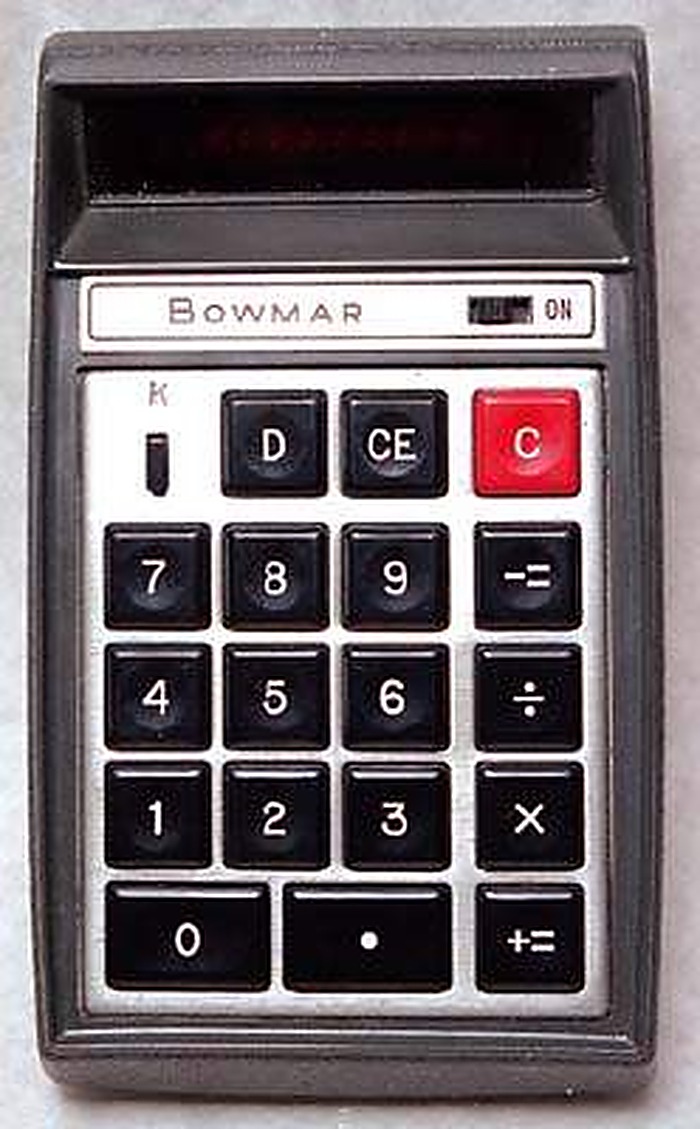
The Bowmar 901B — the "Bowmar Brain". Image courtesy of Vintage Calculators Web Museum.
What the 901B actually was
The Bowmar 901B was a four-function electronic calculator — add, subtract, multiply, divide — with an 8-digit red LED display. It measured 5.2 by 3.0 by 1.5 inches, fit in a jacket pocket (barely), and ran on a rechargeable battery. Bowmar Instrument Corporation of Fort Wayne, Indiana, released it in late 1971 at a suggested retail of US$240, which is roughly $1,800 in 2026 dollars after inflation.
Inside was a single integrated circuit from Texas Instruments — a descendant of TI's "Cal-Tech" prototype work from the late 1960s — that handled every arithmetic operation on one piece of silicon. Before the calculator-on-a-chip, desktop electronic calculators needed dozens of ICs and weighed 30-plus pounds. The TI chip inside the Brain compressed all of that into a package about the size of a postage stamp.
Bowmar did not invent this. Japan's Busicom LE-120A "HANDY" beat the 901B to market earlier in 1971 using a Mostek MK6010 chip. What Bowmar did was package the technology for American consumers and get it onto shelves at Macy's and in the Sears catalog. The 901B was the first pocket calculator most Americans ever saw in person.
Why the Brain mattered
The 901B proved three things at once, and each of them rewired an industry.
Consumers would pay $240 for arithmetic. In 1971 that was more than a decent color TV. Before the Brain, the conventional wisdom in the electronics industry was that pocket calculators were a novelty for executives and engineers with expense accounts. Bowmar sold roughly 500,000 units of the 901B and its successors in the first two years. Demand was not the problem. Supply was.
The slide rule was finished. For 300 years, the slide rule was how engineers calculated. By 1975 it was dead. Keuffel & Esser — the dominant American slide rule maker — stopped producing them in 1976. An entire craft skill, taught in every engineering program in the country, became obsolete in roughly 60 months.
Mechanical calculators were finished too. Friden, Marchant, Monroe, Olivetti — companies that had built giant clattering desktop comptometers for bookkeeping — either pivoted to electronics or collapsed. The comptometer, once as common in American offices as the stapler, was gone within a decade.
The chip-supplier betrayal
Here is where the 901B story turns into an MBA case study. Bowmar did not make semiconductors. It bought the brain of the Brain from Texas Instruments, and it bought the LED display modules from — well, mostly from itself, because Bowmar's original business was LED displays. The 901B was Bowmar's vertical-integration play: instead of selling components to calculator makers, become a calculator maker.
TI noticed. In September 1972, Texas Instruments released the TI-2500 "Datamath," a four-function pocket calculator selling for $149.95. The chip Bowmar was buying from TI was now sitting inside a competing product from TI — and TI could set the transfer price on the chip to whatever they wanted, and cut it whenever convenient.
They cut it. Repeatedly.
The calculator wars of 1972–1975 were a bloodbath. Prices on basic four-function calculators fell from $240 to around $100 in 1972, $50 by 1973, $20 by 1975, and under $10 at the low end by 1976. Every six months the chip got cheaper, the margin got thinner, and the survivors were the companies that either owned the fab (TI, National Semiconductor, Rockwell) or owned a premium brand that could justify a higher price (HP, with its scientific and programmable lines).
Bowmar was neither. The company reported a $20 million loss in fiscal 1975, exited the consumer calculator business, and filed for Chapter 11 bankruptcy protection in February 1976. The industrial-electronics division survived under different ownership for decades, but the calculator business — the thing that made Bowmar a household name for about 36 months — was over.
The price collapse, in one table
Rough US street price of a basic four-function pocket calculator, by year:
- 1971 — $240 (Bowmar 901B)
- 1972 — $150 (TI-2500 Datamath)
- 1973 — $70–$100
- 1974 — $40–$60
- 1975 — $20–$30
- 1976 — $10–$20 (commodity)
That is a 90%-plus price collapse in five years on a product that did the same thing at the end as it did at the start. Nothing about addition got better between 1971 and 1976. What changed was manufacturing scale and chip yields — and the economic rents Bowmar had briefly captured got competed away as soon as the chip supplier decided to capture them instead.
The lesson: component suppliers always come for your lunch
The Bowmar story is the first clean example of a pattern that keeps repeating in the electronics industry: when you build a finished product on top of somebody else's critical component, and that component is the 80%-of-the-bill-of-materials part, the component supplier will eventually look at your margins and decide they want them.
Watch the pattern recur:
- Intel vs. the PC clone makers (1980s–2000s). Intel sold CPUs to Compaq, Dell, HP, and a hundred no-name Taiwanese box-stuffers. Over two decades Intel captured the majority of the profit pool in PCs through branding ("Intel Inside") and pricing power.
- Qualcomm vs. Android phone makers (2010s). Same story with modems and SoCs. Samsung eventually built its own Exynos chips to escape. Most others could not.
- Apple vs. Foxconn. Apple learned the lesson and played it the other way: they own the chip design (Apple Silicon, since 2020) and rent the factory. Foxconn is the modern Bowmar — a contract manufacturer captured by a customer who owns the critical IP.
- NVIDIA vs. everyone (right now). Every company building an AI product on top of CUDA and H100s is in exactly Bowmar's 1971 position. The component supplier has the leverage. The finished-product margin is borrowed.
The rule, stated plainly: if you do not own the scarcest component in your product, you do not own your margin. Bowmar owned LED displays, which turned out not to be the scarce thing. TI owned the calculator-on-a-chip, which was. Bowmar got five quarters of windfall profits and a decade of cleanup.
What it displaced, and what replaced it
The four-function pocket calculator — the thing the Bowmar Brain invented as a consumer category — is still with us. It is the basic calculator at the top of this site, and the app icon on every smartphone. The interface has barely changed in 55 years: ten digits, four operations, equals. What changed is that the hardware went from $240 with a red LED display to free, running as a few hundred lines of JavaScript in a browser tab.
Frequently asked questions
Who invented the calculator-on-a-chip?
Texas Instruments engineers Jack Kilby, Jerry Merryman, and Jim Van Tassel built the original "Cal-Tech" prototype in 1967, which became the foundation for TI's single-chip calculator ICs. The first actually-shipping calculator-on-a-chip was the Mostek MK6010 in early 1971, used in the Busicom LE-120A. TI's equivalent chip, which powered the Bowmar 901B, followed later the same year.
Was the Bowmar Brain actually "pocket-sized"?
Technically yes, practically barely. At 5.2 × 3.0 × 1.5 inches it fit in a jacket pocket but not comfortably in jeans. The first truly slim pocket calculator was the Sinclair Executive from August 1972, which was less than a third of an inch thick. The Brain was the first American pocket-sized calculator; the Sinclair was the first one you could actually forget you were carrying.
Why did Bowmar name it the "Brain"?
Marketing. Bowmar wanted to position the 901B as a thinking device rather than a bookkeeping tool, and "Bowmar Brain" was the advertising tagline that stuck in consumers' minds. The company leaned into it — later ads in 1972–73 just called the product line "the Brain" without bothering to mention the model number.
Could Bowmar have survived?
Probably only by doing what Intel did a decade later: moving up the value chain into chip design and fabrication. Bowmar tried. They acquired a semiconductor operation in the mid-1970s and attempted to build their own calculator chips, but they were years behind TI on process technology and could not close the cost gap fast enough. By the time their fab was running, the market had commoditized and the retail margin had evaporated.
Try it yourself
The Brain did four things: plus, minus, times, divide. Every pocket calculator since 1971 has done those same four things. Run them on the basic calculator and remember — in 1971, that button press cost about 60 cents of 2026-dollar hardware. Today it costs essentially zero. That is what 55 years of Moore's law and component-supplier disintermediation will do to a product category.
Further reading
- Wikipedia — Calculator: Pocket calculators. Covers the Bowmar 901B release, specs, and context within the 1971–72 pocket-calculator race.
- Computer History Museum — Online Collections. The CHM holds a Bowmar 901B in its permanent collection along with the Busicom LE-120A and TI Cal-Tech prototype.
- Vintage Calculators Web Museum — Bowmar 901B. Detailed photographs, internal board shots, and period advertising for the Brain.
This article is for general education. Historical dates and prices are drawn from cited sources; minor variations between retailers and regional markets existed in the 1971–76 period. See our Terms.