The Abacus: The Original Calculator That Outlasted Every Replacement
It is roughly four thousand years old. It beat an electric calculator in a head-to-head speed contest in 1946. It is still being taught to first-graders in Tokyo. Every "revolutionary" calculator since — Pascal's Pascaline, the Curta, the Friden mechanical, the Bowmar Brain, the iPhone calculator app — has come and gone while the abacus just kept clicking. This is the story of the most stubborn computing device ever made.
Last updated: May 11, 2026.
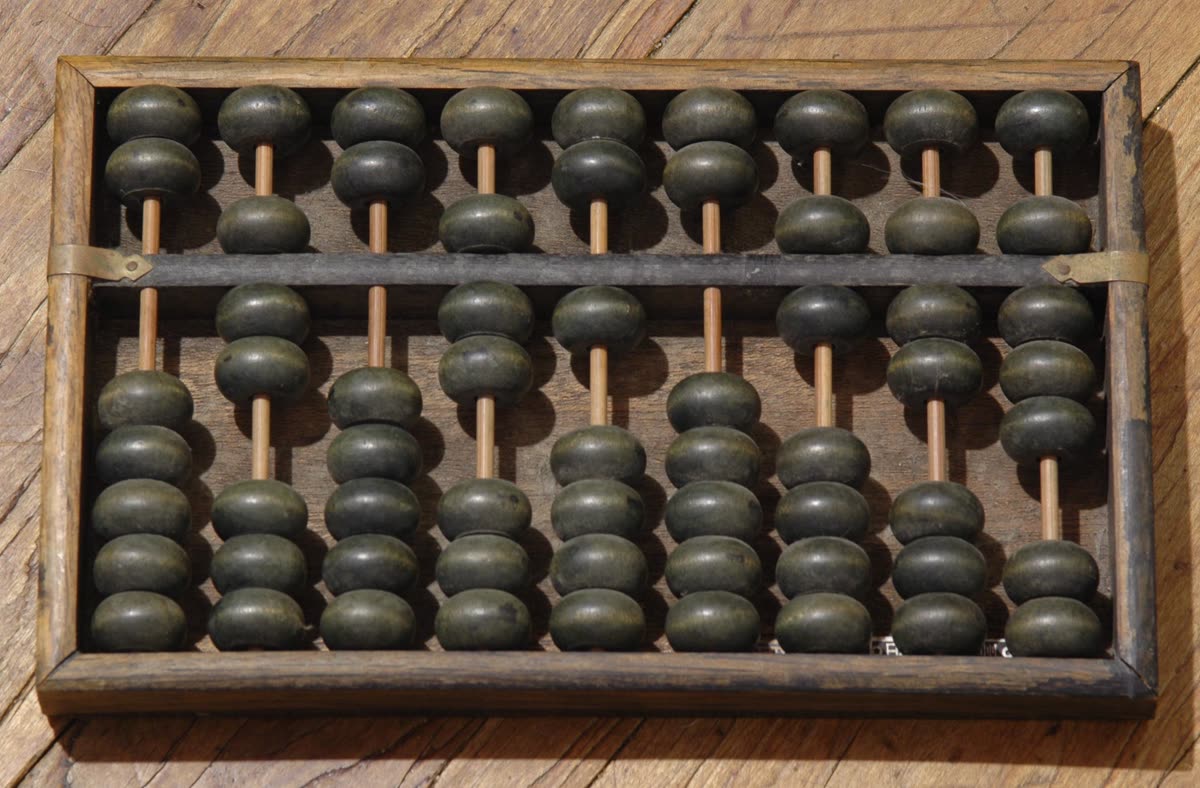
A traditional Chinese suanpan — the 2/5 abacus that dominated East Asian commerce for roughly 700 years. Photograph by Dave Fischer (Wikimedia Commons), used under CC BY-SA 3.0.
What an abacus actually is
An abacus is a counting frame with beads or stones that slide along rods or grooves. Each rod represents a place value — ones, tens, hundreds, thousands — and the position of the beads represents the number stored on that rod. That is the entire device. There are no gears, no hinges, no springs, no batteries, no screen.
Arithmetic happens in the operator's head. The frame is a memory aid — it holds the intermediate results so the human computer can keep their attention on the next operation. In modern terms the abacus is a register file; the CPU is the person.
This is the key idea that gets missed when people call the abacus "primitive." A skilled soroban operator does not move beads to compute — they compute mentally and move beads to store. The bead-pushing is just I/O. The actual processing has always been wetware.
A very fast tour through 4,000 years
The earliest known counting boards are Sumerian, dating to around 2,300 BCE — slabs of clay or stone marked with parallel lines, with pebbles moved across them to track quantities. The word "abacus" itself comes from the Greek abax, meaning "board" or "tablet," via the Hebrew ʾābāq, "dust" — a reference to dust-covered boards used for figuring.
Major variants in roughly the order they appeared:
- Salamis Tablet (c. 300 BCE). The oldest surviving counting board, a marble slab discovered on the Greek island of Salamis in 1846. About 149 by 75 centimeters, marked with parallel lines for Greek numerical notation. Now at the National Archaeological Museum of Athens.
- Roman hand abacus (1st century CE). A small portable bronze plate with grooves and sliding beads. Pocket-sized — early enough that the Romans had a working pocket calculator about 1,900 years before the Bowmar Brain.
- Chinese suanpan (around 14th century CE, possibly earlier). The familiar 2/5 wooden-frame abacus — two beads above a horizontal bar, five below, on multiple vertical rods. The 2/5 design supports both base-10 and base-16 (the latter mattered for traditional Chinese weights, where 1 jin = 16 liang).
- Russian schoty (17th century). Horizontal frame, ten beads per wire, no divider bar. Became the dominant calculating tool of the Russian Empire and Soviet Union, sitting on every shopkeeper's counter from Moscow to Vladivostok until the 1980s.
- Japanese soroban (around 1850). A simplification of the suanpan to 1/4 layout (one bead above, four below), purely decimal. Faster for base-10 work, which by the mid-19th century was the only base anyone outside specialists cared about.
- Cranmer abacus (1962). Tim Cranmer's adaptation for blind users — felt-backed beads that stay where you put them instead of sliding freely. Still the standard arithmetic-instruction tool in schools for the blind worldwide.
The 1946 Tokyo contest: abacus 4, electric 1
This is the part of the story that always surprises people, so it deserves the receipts.
On November 12, 1946, in Tokyo's Ernie Pyle Theater, the U.S. Army newspaper Stars and Stripes sponsored a public contest between Kiyoshi Matsuzaki of the Japanese Ministry of Postal Administration, equipped with a soroban, and Private Thomas Nathan Wood of the U.S. Army of Occupation, equipped with an electric calculator (a heavy desktop unit roughly the size of a microwave oven, the era's state of the art).
Five categories. Five rounds.
- Addition. Long columns of large numbers. Soroban won.
- Subtraction. Soroban won.
- Multiplication. Electric calculator won — the only category where mechanical brute force beat the human.
- Division. Soroban won.
- Composite problem (addition, subtraction, multiplication, and division mixed). Soroban won.
Final score: 4–1, soroban. Stars and Stripes ran the headline "Civilization, on the threshold of the atomic age, tottered Monday afternoon as the 2,000-year-old abacus beat the electric calculating machine." The wording is overheated, but the result is real and well-documented.
What the contest actually proved: for everyday arithmetic on numbers humans care about — payroll, ledgers, taxes, change at the till — a trained human with a $5 piece of wood was faster than a $700 electric appliance. It would take another 25 years and the Bowmar Brain to change that. (For the bead-to-chip handoff, see our piece on the Bowmar 901B.)
Why the abacus survived
Every other pre-electronic calculating device has been buried by progress. The slide rule died in five years once the pocket calculator arrived. Mechanical adding machines — Friden, Marchant, Monroe, the comptometer — collapsed in the same window. Even the Curta, the gorgeous hand-cranked Austrian pepper grinder of mechanical computing, is now a collector's item rather than a working tool.
The abacus did not collapse. It changed jobs.
Three things kept it alive:
It is a teaching device, not just a tool. Operating a soroban builds a mental model of place value, carrying, and borrowing that transfers directly to arithmetic without the device. This is why Japan never stopped teaching it — kids who learn soroban consistently outperform peers on basic arithmetic and short-term number memory tasks. The abacus is, in effect, the world's oldest math-pedagogy hack.
It has zero failure modes. No battery to die. No screen to crack. No firmware to update. No company to go out of business and orphan the product. A suanpan from 1850 still works exactly as well as one made in 2026, which is exactly as well as one made in 2226 will. Almost no other technology in human history can make that claim.
It is the accessibility tool. Cranmer abacuses are still the primary arithmetic-instruction tool for blind and low-vision students. There is no electronic device that does the same job — silent, tactile, no power required, no screen reader latency, fully under the user's hands. Forty years into pocket calculators and seventy into computers, the wood-and-beads version is still the default.
Anzan: the abacus you can't see
The strangest descendant of the abacus is no abacus at all. It is called anzan, Japanese for "mental calculation," and it is what happens when an experienced soroban student stops needing the physical bead frame.
Anzan practitioners visualize a soroban in their head and move imaginary beads. They will sit at a table with their hands twitching as if pushing real beads, performing arithmetic on numbers that flash on a screen at one digit per fifth of a second. National-level Japanese anzan competitors can sum twenty 3-digit numbers presented at that speed, in their heads, in roughly four seconds.
This is the deepest evidence that the abacus was always more about cognition than mechanics. The frame was a scaffold for a way of thinking about numbers; once internalized, the frame can be taken away and the thinking remains.
Modern pocket calculators do not produce anzan. They produce calculator dependence — punch in the digits, read the answer, no internal model required. Whether that is progress depends on whether you measure progress by speed of single answers or by the durability of the underlying skill. The Japanese education system has voted, repeatedly, for the durable skill. (For more on what calculators do to mathematical intuition, our piece on degrees vs radians has a related angle.)
The lesson: simple things outlast their replacements
The abacus is the cleanest example in computing history of a deeply unfashionable principle: the floor of complexity is a competitive advantage.
You cannot simplify a wooden frame with beads. There is nothing left to take away. There is no version 2.0 that fixes a critical bug, no end-of-life announcement from the manufacturer, no "this device will stop receiving security updates after September." The abacus reached the bottom of its problem space approximately 600 years ago, and once you reach the bottom, the only direction is sideways.
Every other calculator in history has been a step on a ladder. The Pascaline got replaced by the Friden, which got replaced by the electric desktop, which got replaced by the Bowmar Brain, which got replaced by the TI-2500, which got replaced by the smartphone, which is currently getting replaced by voice assistants and AI. Each step trades durability for capability — more functions, faster operation, smaller form factor, all of it dependent on a longer and more fragile supply chain.
The abacus traded nothing. It does very few things, but it does them with no upstream dependencies. That turns out to be enough to last 4,000 years.
The lineage, in one table
Major abacus variants and roughly when each became dominant in its region:
- c. 2,300 BCE — Sumerian counting boards (clay/stone slabs)
- c. 300 BCE — Salamis Tablet (Greek marble counting board)
- c. 100 CE — Roman hand abacus (portable bronze, grooved)
- c. 1300 CE — Chinese suanpan (2/5 layout, decimal + hexadecimal)
- c. 1600 CE — Russian schoty (10-bead horizontal)
- c. 1850 — Japanese soroban (1/4 layout, decimal-only, simplified)
- 1946 — Soroban beats electric calculator 4–1, Tokyo contest
- 1962 — Cranmer abacus (felt-backed, accessibility standard)
- 1971 — Bowmar 901B ships; pocket-calculator era begins
- 2026 — Soroban still in Japanese national curriculum
Frequently asked questions
How does an abacus actually do multiplication?
The same way you do it on paper, but using bead positions to hold partial products. To multiply 23 × 47, the operator works one digit at a time: 7 × 3 = 21 placed in the rightmost columns, 7 × 2 = 14 placed one column to the left, 4 × 3 = 12 placed one column further, 4 × 2 = 8 placed one column further, then everything is summed by sliding beads. A trained operator does this in seconds; the bead frame just holds the running totals so the human doesn't have to. You can do the same thing on our basic calculator — but you will be using your fingers as the I/O instead of beads.
Did the abacus influence positional notation?
The other way around, mostly — the abacus reflects positional notation rather than causing it. But the suanpan's structure (rods as place-value columns, beads as digits within a column) is one of the cleanest physical embodiments of place-value arithmetic ever built, and it was almost certainly a teaching aid that helped place-value systems spread across East Asia. There's a strong case that comfort with the abacus made the transition to Hindu-Arabic numerals smoother in regions that had a long abacus tradition.
Why does the suanpan have a weird 2/5 design?
Because the traditional Chinese measurement system used 16 liang to the jin, and 2 beads above × 5 beads below gives you a maximum of 15 per rod — exactly enough to represent a hexadecimal digit. When weights matter and your weight system is base-16, a 2/5 abacus does decimal AND hexadecimal calculation on the same hardware. The Japanese soroban dropped to 1/4 in 1850 because Japan had standardized on decimal-only weights and the extra beads were dead weight.
Can I learn to use a soroban as an adult?
Yes — the basic operations (addition and subtraction) take a few hours to grasp and a few weeks of daily practice to do at useful speed. Multiplication and division add another month or two. Reaching the level of the 1946 Tokyo champion takes years of daily practice; reaching the level where a soroban is faster than punching digits into your phone takes maybe 6–12 months of consistent work. Most adult learners give up around week three because the early speed gains plateau before the real fluency starts. Push through that and the rest comes.
Try it yourself — and try the descendant
The abacus did four things: add, subtract, multiply, divide. Every calculator since 1971, including the one running in your browser tab right now, does the same four things. The hardware has changed beyond recognition; the job description hasn't changed at all.
Run the same operations on the modern descendant — our basic calculator — and remember that the device clicking under your fingers is doing exactly what a wooden frame did in a Beijing tea house in 1450, what a bronze plate did on a Roman tax collector's desk in 75 CE, and what a clay slab did in a Sumerian granary in 2,300 BCE. The interface has changed five times. The job hasn't changed once.
Further reading
- Wikipedia — Abacus. Comprehensive overview of variants, history, and the 1946 Tokyo contest.
- Wikipedia — Soroban. Detailed coverage of the Japanese 1/4 abacus, anzan technique, and modern Japanese curriculum.
- National Archaeological Museum of Athens — Salamis Tablet. Background on the oldest surviving counting board.
- Computer History Museum — Online Collections. Holds multiple abacus variants alongside the Bowmar 901B and other early electronic calculators.
Related on Best Calculator
- The Bowmar Brain: How the First American Pocket Calculator Changed Everything — what eventually displaced the abacus in the West.
- Degrees vs Radians: When to Use Which — another piece on the gap between calculator output and mathematical intuition.
- How to Calculate Percent Change Without Getting the Direction Wrong — a worked-example article in the same plain-English style.
This article is for general education. Historical dates and details are drawn from cited sources; some early dates (especially Sumerian counting boards and the spread of the suanpan) carry archaeological uncertainty of decades to centuries. See our Terms.